Showing posts with label books about iran. Show all posts

Thursday, June 1, 2023

A Story of Two National Narratives


In everyday diplomatic practice, national narratives are sometimes the hardest part to overcome. Rooted in mentalities and national representations, those stories do represent sometimes the chore of the identity itself. Once removed or readjusted, particularly if suddenly, may create dramatic identity rifts.

Republics of Myth. National Narratives and the US-Iran Conflict is a co-authored volume of analysis by Hussein Banai, Malcolm Byrne and John Tirman displaying and explaining the complex interactions - mostly behind the public eyes - between the two nations at war. A war of words, a war of decisions, a war of the narratives.

The authors are very informed, using local knowledge and national intelligence archives, which makes the information provided valuable and reliable. However, like in the case of the national narratives skillfully analyses, it´s always a matter of perspective and no matter how much information you may have on a topic, the choice of the topic itself is subjective. Definitely, Iran and US do have conflicting narratives, sometimes fuelled by other interests than the ones aiming at improving their own nations. On the other hand, neglecting the horrible human rights record and abusive character of the Iranian regime against their own people, which makes far more victims than the sanctions, may look dubious given the tremendous available information the authors had at their disposal.

There are aspects regarding international terrorism the regime in Tehran supports in the region, but without a throughout analyses that may reveal in fact why allowing them to own a nuclear bomb may be controversial. Minimising international critics agains the Nuclear Deal as being issued by the ´pro Israel lobby´ - I´ve lost count how many times this expression it was mentioned in the book - is distoring the value of the information provided and analyses.

Another rather controversial take is using geopolitical paradigms of ´border expansion´ which do have a highly controversial reputation, being used in various expansionists ideologies. Comparing the expansion of the US interests towards the Middle East with the previous expansion to the (wild) West, a a race for resources, largely uncritically, needed more than a paradigmatic translation in a completely different and much more complex context.

Republics of Myth is an important book for anyone interested in conflictual national narratives and their part in fuelling international conflict, but should be rather took with the very critical take, which is exactly how academics and intellectuals in general should consider any given facts, particularly of recent historical relevance.

Rating: 3 stars


Saturday, December 24, 2022

Side notes on a Revolution in the making

With the Iranian revolution heading to its 100 days of protests, there are clear signs that there is no turning back. The wave of contestation of the mullah-lead regime and the extreme violence of the counter-reaction of the different layers of the establishment leaves no place for ´dialogue´ or ´reform´, as some interested voices of pundits and journalist may be trying to make believe. 

That this will be the last winter under the cleric yoke it´s almost clear. December seems to be a bad months for dictators, and the former Romanian dictator whose last visit before being condemned to death for decades of crimes against his own people was Iran, experienced this on his own skin. What it largely unclear is what will be the next steps of this transformation? Will the perpetrators of the 43 years of dictatorship brought to justice? Would they be able to escape to sunnier lands? Would they eventually use the assets transferred through third outside the country and make a come-back as ´democratic´ participants to the inner competition for power within the incoming free regime?

Reading the notes of the Polish journalist Ryszard Kapuściński who chronicled the last months of the Shah and the instauration of the new clerics´ regime, one may notice a lot of similarities: a ruling elite, with the Shah on the top of it, living in complete denial about the real needs and aspirations of the people; the constant persecution and murder of intellectual elites; the active role of repression forces - like SAVAK - in maintaining the regime and violently discouraging of dissent; the widespread corruption and the large scale stealing of natural resources; the persistence of protests for month before the Shah - at last - and his family decided to leave the country.

There are also many more small differences that do distinguish one regime from the other, one being the desperate blindless of religious fanatics who may not spare anything to stay in power. There is no other danger for humanity than a religious fanatic in position of power. Hence, the refusal to leave the theatre with minimal decency. Also different is the deep hate those mullahs seem to have for the culture of the country they kept hostage.

Even when on the wrong side of history, Iran remains an important regional player and the changes taking place sooner or later within the country may send waves of change across the region. Time will show what kind of changes will be involved and especially who will be the agents of those changes. 

Thursday, January 13, 2022

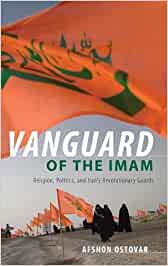
Vanguards of the Imam: Religion, Politics and Iran´s Revolutionary Guards


There is an important element of novelty in the Vanguard of the Imam by Afshon Ostovar, mainly an English-speaking account of the powerful - both economically and politically - Iran´s Revolutionary Guards (IRGC). 

In the author´s words, IRGC is ´a multifaceted organisation with reach into many different areas. It is a security service, an intelligence organisation, a social and cultural force, and a complex industrial and economic conglomerate. It is foremost a military organization´. 

The main question the book wants to answer is: ´What is the IRGC and what makes it such a domineering force in Iran and such an influential player in the Middle East? ´ 

The author uses historical details and contemporary aspects, trying to build a relatively clear landscape where the IRGC operates both internally and externally, particularly its journey towards becoming the strongest political actor in Iran, with its own naval and air forces, among others. All wrapped into a very unique religious interpretation which makes it an interesting - for the political science scholar, but deadly poisonous for those actually depending on it - case study for the mixture between politics and strict religious perspective.

The religious activism extends beyond the country´s border, influencing and creating conflict all around the region, but particularly in relation with Israel. 

Although it goes deep into the ideological and religious roots of this unique organisation, it does not explores further the movement in itself. For instance, a question that at least for me remains unanswered is what is the sociological basis of IRGC, what are the biographies of the members of this hybrid elite? Another important element which is missing, in my opinion, is the evaluation of the extent of the economic outreach which eventually may be an element to keep in mind in the case of a regime change. As it happened in many former communist countries, the control of economic resources by the representatives of the regime continued for a very long time after the political end of the regimes, which created, as in the case of the former Soviet Union, the well known phenomenon of ´moguls´. 

Clearly, the access to the information regarding both the structure of the assets and of the elites is very limited, and those aspects can be further explored. Those shortcoming do not affect the novelty and the rich documentary material used in this book. New angles and approaches will definitely help further research and analysis on topics that are very important for the study of the region as well as of Iran in general.

Friday, November 27, 2020

Book Review: The Shadow Commander by Arash Azizi

Today, as never before was such a need for intellectual clarity and extensive information about the main actors - political, military, other - in the Middle East. Despite the abhorrent character and crimes perpetrated by some, it is important to know to whom belong those names that suddenly make it on the Breaking News. 


The Shadow Commander. Soleimani, the US and Iran´s Global Ambitions by Arash Azizi is a noteworthy and the first substantial research in English on the biography of the general Qasem Soleimani, killed in an American drone attack at the beginning of this year near Baghdad International Airport. 

A ´boy from the margins of the society´, a provincial karateka, his seamless raise on the top of the revolutionary Iran hierarchies and complicated intrigues occured during the Iran-Iraq war and further on, by leading various local operations in his native Kerman. Since January 1988 he was appointed on the top of the Quds - from Arabic al-Quds, ´the Holy one´ referring to the city of Jerusalem - Force that he will lead until his death, turning it ´into the most ambitious expeditionary army in the history of the modern Middle East´.

The soldier-diplomat Soleimani become feared and appreciated - depends on which side of the Sunni-Shia divide one´s stand - for his bloody attacks he perpetrated and the direct, sometimes spontaneous, involvement in various local battles. His death was celebrated openly in Iraq and Syria where his survival victims were still having fresh memories of his attacks. In Iran, a majestic set-up was ordered and display, soon after massive protests all over the country ended in a brutal crackdown. Soon after, the authorities hit accidentally - but refused to acknowledged for a long time - an Ukrainian airplane killing the 176 passengers on board, mostly young people searching for a stable and brighter life in Canada. Indeed, while busy to play bloody cards in Iraq, Syria and Yemen, what a big achievement of the Islamic Revolution and its proxies to be the cause of the massive brain drain in the country´s history!

The current minister of Foreign Affairs, Javad Zarif, is portrayed - frequently and uncritically - as a fine diplomat, aimed to charm and sometimes charmed too, by a Western audience. He may have been more than once in conflict with Soleimani but the fact that he played on his music and acquiesced to the placing of Quds ´diplomats´ that perpetrated or planned acts of terror using the diplomatic network doesn´t diminish his responsibility within the regime. 

Although the book deals with complex Middle Eastern policies, it is written in a very captivating style, with political facts evolving sometimes with a cinematic alacrity. The journalistic, non-pretentious yet informative style helps a lot to avoid information overload. After all, Soleimani was not any kind of academic, but a person of action and this approach suits both the reader and the subject.

Even for someone with basic to middle level of knowledge about local politics and Iranian ambitions, it was interesting to observe how Tehran in the post-Islamic Revolution realm ambitioned in turning into a Moscow of the Middle East. The desperate internationalism with a pregnant Shia Islam outreach ended up by creating deep divisions within the fellow Muslim countries. It also recalibrated dramatically the regional alliances until this very day: Once upon a time, countries like Turkey, Iran and Ethiopia were part of a larger policy of alliances endeavoured by Israel to counter the vocal - but often just for the sake of the cameras - Arab bloc. Nowadays, it´s the other way round, as both Iran and Turkey are lead by personalised regimes endangering the fragile post-Cold War geopolitical balances.

The damage in the region made by violent outtakes authored by Soleimani is hard to evaluate as for now. In the case of the beloved ´Palestinian case´, Soleimani´s interposers played and still playing more or less consciously a game that does not serve a long term solution to the conflict. Actually, it fuelled it by supporting radicalised actors whose only raison d´etre is a permanent state of conflict, otherwise they may be out of work. ´The Quds Force might still claim that it was a ´´voice of the oppressed´´ but in practice it had become an instruments of Iran´s state-based foreign policy of extending Iranian influence in the Aran world and doing so through sectarian Shia proxies´. Although I´ve found a bit forced more than once the comparisons between the left internationalist movements of the Cold War and the Shia-oriented one, when it comes to the Middle East, both Moscow and Tehran may be proud of playing their own dirty games in full disrespect of the free will of the everyday Palestinians. 

Books like The Shadow Commander, on other main regional and Iranian players - no matter their despicability - aimed at an international audience are a very useful source of information for a different, realistic approach of a region that for the time being has the highest potential of ongoing frequent mentions on the Breaking News reports.

Rating: 4.5 stars

Disclaimer: Book offered by the publisher in exchange for an honest review 

Monday, August 10, 2020

A Modern History of Iran by Abbas Amanat

Iran: A Modern History by Abbas Amanat is a massive historical compedium, which resumes 20 years of work and a time span which covers five centuries. Iran is very often mentioned nowadays in purely political context but few are those - including among journalists and especially politicians - with at least a basic knowledge about this country.

The reason is not only because they might not want to but there is a relative scarcity of general, well-structured information about Iran. One can find snapshots of various kinds of information, but rarely a big picture which covers important data such as historical context, geographical delimitations, economic background, political evolution and cultural developments. 

Abbas Amanat, director of Yale Program in Iranian Studies, was able to introduce to the reader all those details in over 1000 pages of history. It starts with the 16th century with the Safavid Empire, but it offers an overview of the previous historical sequencies by placing the Persians in the world tempo of the previous centuries. The book relies on a multiplicity of sources, double checked and neutraly introduced into the narrative. The research ends with the Green Movement - the protests following the fraudulent presidential elections from 2009. 

The book combines chronological details while following mentality patterns and structures which helps to better understand the religious and political developments and the conflicts and interferences of the two, as well as the positioning of Iran in modern times in various geopolitical contexts. From the conceptual point of view it is an excellent way to offer a basic timeline while filling it with information that helps to understand not only the moment when the events are taking place, but also the bigger picture of the time, what F. Braudel and Ecole des Annales labelled as the long durée.

Personally, I reserved a couple of months to go through the information and most probably will need at least one year to get into more details of various historical time frames and events mentioned more or less in detail. Besides translating in a simple but not simplistic way the realities of six centuries of dense Iranian history, Iran: A Modern History is also a noteworthy example of how to write histories nowadays. Recommended to anyone curious to find more about Iran than what is usually featured in the media but also to historians patient enough to learn not only about a country, but also searching for their writing style.

Rating: 5 stars

Disclaimer: Book offered by the publisher in exchange for an honest review


Monday, May 11, 2020

Book Review: Akbar Ganji The Road to Democracy in Iran

´Much of what needs to change in Iranian culture relates to the superstition, dogmatism, conformism, and prejudice that have permeatged our society, particularly in the Shia seminaries. Rejecting these aspects of the dominant religious culture in no way implies rejecting religion. Indeed, a considerable number of democratic reformist activities in Iran hold deep religious beliefs. But without reform of these aspects of religious culture in Iran, democratic change will fail´.
Akbar Ganji, the author of this quote, has an interesting intellectual story, but not unique for non-democratic regime stories. With a lower class background, he was member of the Iranian Revolutionary Guards and at times, bodyguard of the ayatollah Khomeini, followed by a career in diplomacy and as a journalist. After investigating the so-called Chain of Murders, targeting intellectuals killed the regime, among which Dariush and Parvaneh Farouhar, he spent six years in Evin prison. Following his release he turned into an active supporter of democratic change in Iran.
The Road to Democracy in Iran, a collection of essays published by Boston Review Book, with foreword by Joshua Cohen and Abbas Milani, outlines the main directions that will lead to democracy in Iran. The essays are based on general ideas - such as human rights and the open society as featured by Karl Popper, a familiar reference among Iranian intellectuals - and do not contain a detailed platform of step-by-step changes. However, it assigns to intellectuals the role of forerunners both in terms of spreading and explaining ideas and pushing forward the democratic change: ´Intellectuals must always strive to lessen other people´s pain, even though they suffer on this path. And they must live in a way that prepares them to tolerate and survive the pain of insult, exile, imprisonment, and even torture´. Indeed, they ´must live´ which also implies that in many situations the intellectuals can be as weak as those that do not enjoy this status. Resisting torture and blackmail is not unfortunately a matter of belief in your ideas and education, it has to do with a moral code that is not the priviledge of the very educated. Ganji related perhaps to his own experience in prison but realistically speaking, under the duress of lack of freedom and torture there is no guarantee of integrity.
A modern - post-ayatollah - Iran advocates for the separation between religion and politics, with the priviledges of the ruling class abolished - (...) it is our goal in Iran to revoke the privileges that rules have taken for tjhemselves and their relatives´; the usual outcome of populist dictatorships that start as a way to increase the access to power to the less privileges and ends up as an elite which separates from the same people it claimed to represent - and the ´gender apartheid´ eliminated. Talking about the peculiar situation of women rights in Iran, I often wonder why there is not a higher awareness and outrage in the Western media about that. The label of ´apartheid´ is so easily used when it comes to various political contexts, but for the case of a country where women are the victims of violence - with morality patrols openly attacking women whose dress code do not conform the rules set by the religious men - and their rights restricted - including of entering a stadium -  it seems that there is not enough to provoke the outrage. Among others, there is no international mechanism that can force Iran to respect women rights, as the Islamic Republic is not member of the Convention on the Elimination of All Forms of Discrimination against Women. 
In a new, democratic Iran, religion is rather a source of solace for spiritual needs than the only solution for all problems, including political and economic. In any case, Akbar Ganji is supporting a ´modernist Islam´ that ´considers the rational mind a tool for finding the truth in the holy book and in hadith, but also for apprehending other sources of knowledge´. 
The Road to Democracy in Iran has the merit of setting the basis of the possible political and intellectual change in the country. It is though rather an intellectual manifesto than a clear program that settle the details of the change. Obviously, from the perspective of the elites and the everyday operation of the political - and religious - establishment, there are many more details that need to be considered which are clearly not the object of this book. 
From many respects, it is good and hopeful to read such books as it promises a post scriptum to the dictatorship of the mullahs. The clear terms and content of this afterwards is yet to be written, hopefully by people that believe in democratic change, hopefully among them many women. 

Rating: 4 stars

Tuesday, April 7, 2020

Academic Book Review: Saudi Arabia, Iran and the 40-Year Rivalry...

Kim Ghattas insider´s account of Hilary Clinton´s projects within the State Department, published under the title of The Secretary were a valuable investigation that goes beyond the usual mandate of a politically designated person. It revealed institutional mechanisms and behaviors that are there to maintain the continuity of an institution, the diplomacy, aimed to serve the national interests of a country no matter who is heading the country or the institution. 
Black Wave. Saudi Arabia, Iran and the Forty-Year Rivalry that Unraveled Culture, Religion and Collective Memory in the Middle East is an elaborated cultural and journalistic investigation that goes far beyong what we usually consume in the media nowadays. The book is based on a variety of sources, from history books to interviews with main players in the region or media in seven countries with the aim to give voice to the ´silent majority´ of people who are unable to have their say, caught in the terrible fight for geopolitical survival of their countries.
For someone like me, relatively familiar with the area and its players, but far from being an expert, Black Wave reads almost like a thriller where the roles between criminal and victims are free to switch. 
The starting point is the year 1979, where three important events took place in the region, whose reverberations continue to complicate the mental and geographical map of the region: the Iranian revolution, the siege of the Holy Mosque in Mecca by Saudi zealots and the Soviet invasion of Afghanistan (´the first battleground for jihad in modern times´). 40 years is 10 years over a generation and caught between religious fervors and cynical realpolitik games, those born after this year in the region are asking ´What Happened to Us?´. I would rather ask: ´What they did to us?´
The book evolves in waves, waves of an earthquake with movable epicenter, shaken by the permanent rivalry between Saudi Arabia and Iran. A rivalry with many collateral victims and which viciously self-reproduces with no chance of end in sight. The identities those two countries created for themselves and the ways in which influenced the neighbouring countries are a fact. How many generations will be needed to challenge those structures, that in the case of Lebanon, for instance, are rotting the state from within, it´s a very sad and complex question.
Black Wave is a heavy read and definitely will need more than once to browse a couple of times more my notes before heading to other resources, particularly about religious differences within Islam and intellectual elites. The book creates a solid basis to build on further knowledge about specificities not necessarily within the research range of this terrible - and sometimes horrible - rivalry. 
As for the question of what the future has in store for the people living - and refusing the option of leaving - here, it is largely unknown. A new alignment of events like in 1979 might change everything, but predictions are neither the work of the historian nor the journalist. For sure, the Middle East will remain a valuable source for creating historical encounters, we are far from writing a final/conclusion chapter.

Sunday, January 19, 2020

Academic Book Review: Iran Reframed: Anxieties of Power in the Islamic Republic

The very recent events taking place in Iran demonstrated how rare are the adequate interpretations of this complex society and political regime. How can someone from outside understand in the same narrative the massive street manifestations mourning Qasem Soleimani and the student protests against the regime following the unintentional shooting of an Ukrainian passager plane killing 176 people on board, most of them brilliant young people?
At a certain extent, democracy makes us lazy. In dictatorships, people learn the hard way of fencing with the restrictions and building their oasis of relatively free thinking. Dictatorships, regardless their breed are not made of homogenous chunks but of individuals that despite the high political pressure, they have their own interests and ideas, including sometimes contrary to the accepted school of thought.
Narges Bajoghli's Iran Reframed: Anxieties of Power in the Islamic Republic studies the ways in which authorities are trying to reach the younger generation though media - particularly film - productions. The main question those productions should answer is 'How to transmit the commitment to the revolutionary project from one generation to another?' 
It mainly explores the 'media world' of the Revolutionary Guards and the Basij, an important paramilitary force active in schools, universities and other institutions. The messages are spread through a plethora of foundations, schools and institutions, as well as formats (tv series, documentaries, films). 
However, it does not mean that the success is overwhelming. Sometimes, people involved in producing the narrative do have unique perspectives, some of them - especially veterans of the Iran/Iraq war - may have their own disappointments. Sometimes, the distribution channels of such messages doesn't go smoothly. Often, the target of those messages does not react as expected. 
There are also specific differences between defending the regime (nezam) and criticism of the government (dowlat), between the insider (khodi) and the outsider (gheyr-e khodi). Identifying and understanding those differences are very important in having a better view of different angles and ideological movements within the Islamic Republic.
The author, Iranian-American, based the book on interviews with representatives of the ideological production, plus an extensive knowledge of those productions. Besides offering a different way for interpretation of the Iranian realities, it shares interesting information about the Iranian movie industry, whose development is at least partially due to the massive state interest in ideological production.
My biggest regret though is that the book is too short, as for me it ended in the middle of a very interesting discussion that I was expected to continue at least for more than 200 pages. 

Saturday, January 4, 2020

The Illusions of Royalties: The Shah by Abbas Milani

I grew up in a communist dictatorship in a country that once used to have a king - although a German, non-local dynasty brought to the country by the Big European Powers when they figured out that the local politicians were out of sight and they needed stability in this part of Europe. After the communist took power with the help of the Soviets, the King was exiled in Switzerland and never spoke correctly in the local language of 'his country'. There were also gossips that his family left with a train full of works of art and jewellery, some of them fabricated by the local secret police. 
In the dark days of the dictatorship, when people were starving in cold concrete boxes of matches, and illiterate aparatchiks were in power, the thought that there is a King, somewhere in the beautiful Switzerland who was sending messages to his 'people' via Radio Free Europe was the soul medicine. It means that the country had a chance of normality.
Once the democratic change took place, the King, now of an advanced age, returned to his country. Many people - especially among intellectuals - trusted him and created a little monarchist 'party' dreaming about a right Kingdom in the corrupt country. In other former communist countries - Albania, Bulgaria - inheritors of their fathers' thrones were coming back, welcomed by enthusiastic masses hoping for the same beautiful future as the naive people in my country of birth. Some tried their hand into politics, like Simeon, the Bulgarian tsar, who in a very circumstantial move accepted to be prime-minister.
But the reality showed that those crowned people were out of touch with politics, living in cloud 9th having no idea about what does it mean to manage a country. Their role in mobilizing the imaginary of oppressed people behind microphones of the free media was done. Everyone knew this.
Many are comparing nowadays the situation in Iran with the situation in the communist dictatorships, but they are wrong for reasons that I will not mention right now. But I will focus only on one aspect that given my familiarity with the topic gives me a bit of insight to talk about: the return of the Pahlavi dynasty.
Most of the serious academic accounts and personal accounts from people with a certain unbiased knowledge pledged against it. Besides the grandomanie and the outrageous waste of resources used for personal aims, there is, as in the case of my country of origin royal family, the story of the goods that were stolen from the country. Every time there are protests in Iran, the figure of the Shah and of the monarchy is waved optimistically by international media outlets with a certain bias as Radio Farda and VOA Farsi. The inheritor of the throne appears in the media, launches press releases and his supporters are gathering on the street with the old flag of Iran, screaming in support of the monarchy. In the country, the bloody cynical bureaucrats sending young poor people to death or to prison have a reason to pretend that the protests are, in fact, the puppets of the Pahlavis.    
I was looking for a long time of a reliable monography to figure out by myself about what it really meant the reign of the Pahlavis for Iran and The Shah by Abbas Milani, based on extensive interviews - except the family of the Shah - and archive research was a good start. 
First and foremost, it is written beautifully, which makes easier to navigate the impressive amount of information. I've spent long evenings with this book immersed in the intrigues and small stories accounted for. It reveals a lot about the myth building and nationalism, but also about the history, diplomatic alliances and last but not least, the problematic psychology of this dynasty.
I am very much familiar with European royalties and the entire ritual and philosophy that was built around it starting with the Middle Ages, centered on the Christian traditions and writings. In the case of Iran - and other royal houses in the Muslim world I am partially aware of - there is a completely different approach as it reflects another religious background. The irony was that the Shah was anti-religion, or has a different view on religion than the one of the religious establishment, but maintained a standard of personality cult worthy of the old chronicles of Ferdowsi. Add to it the love for vintage cars, womenazing, and an investor touch that turned all the important businesses in Iran into a provider of income for the extravagant hobbies - like the Zoo on Kish Island (that's my add-on, not in the book). 
What is less known is how the Shah maintained his reign in times when Iran was faced with difficult external decisions, under pressure from both Soviet Russia and the Allied Powers. The book outlines clearly the old connections Soviet Russia started to build into the country from the very beginning of the 20th century, through the Tudeh mostly but later on through its extended network which involves, naturally, KGB spies. 
The Pahlavi times achieved modernisation and started to acknowledge the need of an equal status for women, including by a significant presence of women in public positions and access to universities. It started to change the faces of big cities into architectural works of art, also thanks to the inspiration of the Shahbanou Farah Pahlavi, Shah's third wife which studied - without graduating - architecture in Paris.
But unfortunately for the fate of the country, the Shah was unable to understand the changes taking places among the population, surrounded by sycophants - just like his father - that kept him away from the realities. His alliances, both internal and external were circumstantial and mostly aimed at offering short-term solution to serious grievances. In the words of the author: '(...) the Shah lost his throne because he failed to make concessions at the right time, and because he failed to see the domestic roots of the movement against him'.
What happened after we can still see - although not always properly understand as outsiders: 'The revolution that overthrow him in 1979 was democratic in its nature and its demands. Sadly it begot a regime more despotic than the Shah's own modernizing authoritarianism'. 'The continous tumult in Iranian politics over the last three decades is rooted in the fact that the democratic dreams and aspirations of that revolution were aborted and remain unrealized'.
Will the inheritor of the Pahlavi throne achieve them? My questions are: How? With whom? Why? when you can rather look forward into the future and find the solution which suits the situation and mindset of a generation that has enough of being sold illusions.
In Cascais or Montreux, royalties ghosts are waiting for the right momentum for an interview until the next royal wedding is taking place and they can socialize with their more successful royal peers. In the streets of America or Europe, people with a sour heart of the exile wave pro-monarchists banners and praise the Shah.
Everyone has a dream, but no dreams are equal. Some might easily turn into nightmares.