Thursday, January 13, 2022

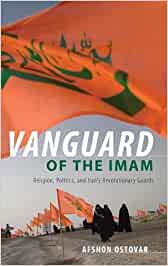
Vanguards of the Imam: Religion, Politics and Iran´s Revolutionary Guards


There is an important element of novelty in the Vanguard of the Imam by Afshon Ostovar, mainly an English-speaking account of the powerful - both economically and politically - Iran´s Revolutionary Guards (IRGC). 

In the author´s words, IRGC is ´a multifaceted organisation with reach into many different areas. It is a security service, an intelligence organisation, a social and cultural force, and a complex industrial and economic conglomerate. It is foremost a military organization´. 

The main question the book wants to answer is: ´What is the IRGC and what makes it such a domineering force in Iran and such an influential player in the Middle East? ´ 

The author uses historical details and contemporary aspects, trying to build a relatively clear landscape where the IRGC operates both internally and externally, particularly its journey towards becoming the strongest political actor in Iran, with its own naval and air forces, among others. All wrapped into a very unique religious interpretation which makes it an interesting - for the political science scholar, but deadly poisonous for those actually depending on it - case study for the mixture between politics and strict religious perspective.

The religious activism extends beyond the country´s border, influencing and creating conflict all around the region, but particularly in relation with Israel. 

Although it goes deep into the ideological and religious roots of this unique organisation, it does not explores further the movement in itself. For instance, a question that at least for me remains unanswered is what is the sociological basis of IRGC, what are the biographies of the members of this hybrid elite? Another important element which is missing, in my opinion, is the evaluation of the extent of the economic outreach which eventually may be an element to keep in mind in the case of a regime change. As it happened in many former communist countries, the control of economic resources by the representatives of the regime continued for a very long time after the political end of the regimes, which created, as in the case of the former Soviet Union, the well known phenomenon of ´moguls´. 

Clearly, the access to the information regarding both the structure of the assets and of the elites is very limited, and those aspects can be further explored. Those shortcoming do not affect the novelty and the rich documentary material used in this book. New angles and approaches will definitely help further research and analysis on topics that are very important for the study of the region as well as of Iran in general.

Sunday, December 26, 2021

Talking Tongues


Canada is frequently branded as a multicultural country, but what exactly this multiculturalism means and how does it apply in practice, we rarely read or talk about. At least outside the Canadian realm. 

The Art of Leaving by Ayelet Tsabari was one of my favorite memoirs I´ve read in 2019 and therefore,  I refused to wait any longer for getting my hands on Tongues. On Longing and Belonging Through Language, co-edited with Eufemia Fantetti. The book. which was published in the second half of 2021, is a collection of 23 literary voices based in Canada sharing their experience with their mother tongue, as well as with languages - loaned, owned, forgotten etc.

Although the essays are not necessarily equal, there are interesting aspects pertaining to languages which are important for understanding the existential value of words, mother tongues and languages. As there are over 260 million people not living in their country of birth, the ways in which one can operate - or fail to - in a second language, need a throughout and detailed investigation. The personal accounts are very important for understanding the multiple impact of languages on everyday life and even mental health and health in general.

As Kamal al Solaylee testifies, he had to give up Arabic because this language was lacking ´the vocabulary and textual resources to help me accept who I am´. A new language was the safe place for building up an authentic life. As Logan Broeckaert observed, gender is ingrained into the language therefore, not innocent. For Karen McBride, returning to her original native culture and language was a return to herself: ´It has taken a long time to find the confidence to live in the body and the skin I´ve been given´. Those learning their mother tongue - as in the tongue spoken by their mother and ancestors - may have a different mental and life experience, as shared by author Jenny Heijun Wills whose newly learned Korean language was part of the connection she started to build with her family of birth, she was separated from through adoption. Another - yet different - Korean linguistic experience is shared by the translator Janet Hong. For Rebecca Fisseha, her experience as a writer brought her closer to her Ethiopian heritage and language.

Languages are experienced differently and are supposed to be loved differently. Melissa Bull explained how not only her voice and demenour change when switching from English to French. As a political refugee from El Salvador, Leonarda Carranza ended up figuring up that in fact, what she used to called ´mother tongue´, the Spanish language, was in fact a tool of domination that deterred her from her natural connection with her native culture. In same cases, as Teochew-Chinese-Persian author Sahar Golshan explained the efforts of recovering lost languages can turn into a ´lifelong obsession with the accumulation of missing vocabulary´. Therefore, there is a certain loss of self that comes with the loss of a language, as argues Téa Mutonji. 

We need language, and words, as much as we need air and water. In Kai Cheng Thom´s words - in the beautifully titled essay Language is the Fluid of Our Collective Bodies - ´I believe that language is the fluid within the collective body: like plasma, like blood, like spinal fluid, it carries nutrients and information from one unit to another´. Thus, the painful process of returning to languages stolen through various political processes, as explained by Rowan McCandless: ´I mourn the many languages that were taken from me, the possibility of not being viewed as an outsider or defined by the colour of my skin´. 

But language means more than simple grammar and vocabulary. Indeed, as Amanda le Duc explained our way to refer to people with various disabilities is a language in itself which labels and discriminates. ´We say that we don´t actually think that people who are less intelligent are worthless, but our language reinforces these ideas´. Tongues can also be without words, as it is the case of the sign language, whose linguistic power is explained in the contribution by Adam Pottle. Being a writer with a learning disability, as shared by Jagtar Karn Atwal, makes the writing and the language experience even more painful from the existential point of view: ´Reading makes me feel as if I´m drowning in a sea of moving words´.

Languages are love, and by learning one, it is not only possible to gain a new life, but they bring one close to the source of life, love. Sigal Samuel asks, thinking about her father: ´does my dad learn foreign languages to gain access to women he loves, or is falling in love an excuse for him to learn another language? Either way, I looked at it, the answer was yes´. ´They say the language you speak shapes your thoughts, and so it does´, outlines Ashley Hind.

Ayelet Tsabari experiences languages in very different ways. Obliterated for various nation-building reasons, the Arabic of her Yemen family resurges when she, like many other second or third generation of Israeli with roots in Muslim lands, assume this part of their identity. ´A language, I want to believe lies dormant in my body, genetically encoded into my cells, waiting to be awakened, activated´. As a writer, she is represented by English, and switching between Hebrew and English, may be worrisome: ´Writing in a second language (...) is like wearing someone else´s skin, an act akin to religious conversion´. ´Whenever my Hebrew flows, I worry my English is at risk´ - this is a thought many of us, writing in a second or third or fourth language are very worried about because coming back to the source of words can be so difficult, while leaving it, the easiest thing on Earth. 

The pandemic is a guest star of many contributions to the collection, as the months-long lockdown and the isolation, may have tempted some of the authors to return to their original, lost languages or just learn a new linguistic skill. Sometimes it worked, sometimes not. 

The personal experiences doubled by the everyday writing challenges makes Talking Tongues an important collection for both writers and language lovers. In addition to revealing more or less problematic aspects of linguistic policies in Canada, it also contributes to the ever growing bibliography on languages and multilinguism in general.

Should/Can Sex be Equally Distributed?


Our choice of sexual partners is a construct. It is made up of our cultural expectations, personal and society-level, of family pressure, of race policies, of race representations...actually, once you start thinking about it, the list of the criteria gets even longer. Never shorter.

Amia Srinivasan collected a couple of very important essays raising fundamental questions about the genesis and the basis of the politics of desire. The Right to Sex raises a couple of very important aspects, discussed in separate essays, all placing sex in the frame of a political phenomenon, framed by decisions fuelled by power - from male supremacy to issues defining the ´f*ckability´ based on very narrow, ethnically-oriented criteria. Although the perspective is mostly philosophical, I appreciated the realism of the approach, which takes into consideration the great extent of political involvement in defining private choices like sex.

Sex turns to be a very explosive political issue though. Being refused the right to sex, for various considerations - physical, mental health, racial - the so-called incels - involuntary celibate, because no one likes them - can fuel a wider frustration that may, in the end, combined with other elements like joblessness, a dangerous case for isolated or mass attacks. 

In a philosophical vein, the essays raise many questions but elegantly refuse to take a stance or another. But sometimes, the questions are enough to play the role of a conclusion. My mind-challenging essay for me is where the sex policies in universities are discussed because putting a certain mental habit into question is a strong statement in itself. 

Probably, a ´redistribution of sex´ is as utopic as a fair redistribution of wealth. However, being aware of what stays behind our body and sex choices it a deconstructivistic step towards eventually looking for alternatives. From the gnoseological point of view it is a very useful philosophical approach that, at least for me, opened my mind a lot of more concepts and approaches I hope to be able to further explore through other essays and further reading.

Sunday, November 21, 2021

Bad News about Media and Democracy


Media is going through a serious identity crisis for over a decade now, not only in the US, but all over the world. Journalists turned into a caste and media are becoming important stakeholders and even part of the political decision-making. They are serving audiences and evaluate their competencies based on how many clicks and comments their articles gathered. What about the public they are supposed to serve? Who are their readers they are expecting to pay for their articles.

Journalist Batya Ungar-Sargon analyses in her latest book Bad News. How Woke Media is Undermining Democracy the radical switch to the left of the American media catering for an educated and rich/middle-class audience. 

´We need a journalism that exposes the class divide in America rather than concealing it; whereby it continues to grow, and not because the working class is worthy of your pity or your compassion´. 

Based on interviews, facts, figures and personal observations, Ungar-Sargon outlines the evolution the journalism in America went through, from a lucrative endeavour aimed at informing a wide range of readers to a corporate enterprise whose survival depends on advertising for products affordable for middle to high-classes. Therefore, this kind of audience should be attracted with a content which is expected from this audience. ´Journalists today are an American elite, a caste that has abandoned the working class and the poor as it rose to the status of American elite´. Therefore conservative institutions as FOXNews made the switch serving the working-class and their agenda. ´Today´s meritocratic elites subscribe to the view that not only wealth but also political power should be the province of the highly educated´. 

The book, although offers an unique and documented overview of the historical evolution of journalism and its lack of diversity in terms of coverage and approaches, it does not consider a couple of elements inherent to the American society - at least, among which a general corporatist orientation which touches upon other professions as well, but also a professionalisation of many other domains, among which journalism as well. Being a journalist, as well as a real estate agent or a shop keeper may require a high degree of professional preparedness, which includes a high-education diploma. An important question would have been at what extent journalism schools do prepare the future journalists to deal with a variety of topics of interests, including adherence to certain ethics´ code. Relevant would have been also the positioning of different journalists´ associations on topics regarding professional standards and ethnic diversity. What about alternative publications and initiatives that may maintain - online particularly - a diverse list of approaches and reporting?

Is journalism completely dead? Can it be revived? 

Batya Ungar-Sargon predicts that ´We must begin to listen to each other again´ without delving too much into details.

I personally think that publications like NYT and other classical sources of information in America are, indeed, biased and not necessarily interested in informing the public opinion. However, I am hopeful that besides the algorithms who literally infested the media reception and the simplistic, copy-pasted like approach to race and ethnicity, there are individual voices that may revive the interest in information and would answer the need of the public opinion of being informed. After all, it is how democracy - no matter where - will survive. 


Monday, November 15, 2021

World War C by Dr. Sanjay Gupta


American surgeon and CNN correspondent Dr. Sanjay Gupta outlines in World War C the further influence the pandemic may have on our everyday life. Is it too early to make predictions? In fact, the speed the world changed and adapted to the restrictions of the virus is tremendous and based on those observations only it is not too risky to assume at least a low level predictability of future trends and patterns.

When the first details of the virus were revealed, Dr. Gupta was having a glass of wine with Francis Ford Coppola assuming casually that an Apocalypse Now was still far from happening. As a reporter who covered the SARS outburst in Asia, he, as many others - including the humble writer of this book review who survived SARS in Asia in a very easygoing way - thought that the new Corona Virus outbreak is either an isolated or easy to contain phenomenon. But it was far from it.

This virus was and continue to be considered like no other pathogen ´the humanity ever seen´. Particularly its transmission pattern defy any other previous model, with a rather random-basis risk of transmission affecting severely affected immune systems. 

Relevant for the times of online conspiracies and anti-scientific feelings, there are extensive chapters dedicated to scientifically explaining the power of vaccines - any vaccines - and the opportunities open up by it for a medically safer realm.  

What I really appreciated in World War C, besides the relatively easy language appealing - hopefully - to many of those not yet sure about the advantages of vaccination - is the reference to the society impact and references. Thus, the recent Corona crisis is not only a medical crisis, but it displays the signs of a system struggle therefore the need of a comprehensive reconsideration of the state policies in this respect, but also a health crisis of the American public - among others - affected by unhealthy eating habits. It involves as well various economic, cultural, social and psychological aspects that may be taken into consideration for a better understanding of the mentality shift we are experiencing in the last year and a half, as well as its impact on our everyday life.

World War C by Dr. Sanjay Gupta is an useful book for students and readers interested in health policies and particularly the ways in which the Corona Virus crisis is challenging our daily lives. As the situation is further under development, this book is relevant for a specific moment in time and resumes intelligently reactions on both sides of the power spectrum in America and the future implications for the rest of the world. 

Friday, November 12, 2021

About Caste, in America


The first thing I´ve noticed from the first until the last page of Caste by Isabel Wilkerson is the beauty of the writing. It is not common sense to associate the fine choice of words and refined paragraphs with academic writing. Rather the opposite, as the point of nonfiction is, among others, to prove various points of views and analyse specific topics. The search for beautiful words though is the last priority of a nonfiction writer as the choice and use of neutral, simple words and clear sentences may serve the purpose of exposing and explaining a certain reality.

However, in this case, the beautiful writing makes the topic more approachable and easier to understand. Caste is a well documented book which uses the author´s personal observations as well as surveys and other academic articles and books on the topic, with a particular focus on India, Germany and the US.

Caste is not necessarily a comparative book but it uses comparison in order to outline the specificities of the American class and caste system. Although the references to the Indian - Hindu-oriented - caste system may provide useful information about how the caste system really works, particularly in issues regarding the main caste pillars, the frequent mention of Nazi Germany and the ostracization of its Jewish population, as compared to the situation of African-American, during and beyong the slavery is fortuitous. For a very simple reason: Nazi Germany wanted to make the Jews dissapear through systematic killing. The discrimination, the cruelty and terror, the purity laws all were aimed to lead, sooner or later, to the disappearance of Jews. An aim which was not endeavoured by the American political system.

´Just as DNA is the code of instructions for all development, caste is the operating system for economic, political and social interaction in the United States, from the time of its gestation´. The American caste system started in 1619, after the arrival of the first Africans to Virginia colony. One of the first decisions of the representatives of the colony was to decide who could be enslaved for life and who could not. Together with race, the caste system is the very basis of the American society: ´Caste is the bones, race is the skin´. Through caste power, resources, respect, authority and ´assumption of competence´ are reproduced on a daily basis. It creates social and political habits and the set the ground of further social and political stability. It combines elements pertaining to evolution and biological laws, but also to theology - the divine Will who designed the society and its members in certain ways - and professional choices. Its heritability enforces a system over and over again, particularly through a legal system which is race-based oriented.

Members of the lower caste - in this case the African-Americans - may end up behaving as they are expecting to: assuming the role assigned, avoiding conflict and delaying the moment when the system may be challenged. Actually, by keeping the members of this caste at a non-educated, uninformed, weak level. They are powerless because they were meant to be this way and even ended up assuming this status themselves.

Although I agree that the election of an African-American president was ´the greatest departure from the script of the American caste system´, only the election in itself did not change, Isabel Wilkerson fails to explain in detail the lack of a clear plan to empower the African-American community. The election of Trump was probably the counter-reaction of the caste system, but things would have been considerably smoothly with a different set of policies aimed to challenge the caste system. After all, Obama had eight full years to do it.

Caste is a fundamental book for understanding the historical and social basis of the caste system in America and its impact of other (non-white) communities, particularly the African-Americans.


Wednesday, October 20, 2021

BILD´s Lost Honour


BILD´s AXEL Springer whose yellow media tactics inspired in the 1970s Heinrich Böll to write a novel, The lost honour of Katharina Blum - turned into film as well - went at the beginning of this week through a turmoil, following an article published in the NYT disclosing the sexual misconduct and other misadventures of the then editor-in-chief Julian Reichelt. The stories surrounding the sex, drugs and money rolls in the Bild´s headquarters were well known for over a year, but the decision to suspend Reichelt was prompted by the latest disclosures in the English-speaking media. The fast answer prompted some bitter yet completely appropriate comments in the German-speaking social media saying that maybe in order for the local authorities to take decisions in sensitive cases - such as, the neo-Nazi networks among the Police and the military - international media should first report about it.

One day after Reichelt was put on leave, AXEL Springer put the dot on the acquisition of POLITICO, a major investment in the English (American) - speaking media. 

Bild´s modus operandi is well known long before Hamburg-born Reichelt - a former war correspondent in Syria, Iraq and Lebanon - whose both parents worked for Axel Springer was put in charge of the newspaper. The aggressive and sometimes misleading journalistic style, with a propension for disclosing personal information for purely sensationalist aims, was a main feature of the newspaper from the very beginning. This style that does not have anything to do with the journalistic ethics and the desire to inform the public was eventually translated to other media outlets the company purchased in Eastern Europe, promoting its brand of (non)journalism. 

In political terms, Bild - and Axel Springer in general - was a trouble maker with its own agenda. From sending balloons on the other (red) side of the Berlin Wall to its support for the state of Israel, and the open opposition to Putin they made many enemies. But when you are in such a sensitive constellation, being very careful with your internal ethics and the people representing you is more than an image move. It automatically connects with the values you assume to represent.

Mate Schönauer and Moritz Tschermak documented with journalistic attention to detail the emotional take on information that Bild started to play, particularly during Reichelt´s reign. Accusations of voyeurism and grotesque mishandling of data, use of personal information posted on Facebook for sensational aims. Selling emotions and feelings instead of information. While playing the game of sexual favors with the female employees, particularly young interns picked up based on their degree of ´fuckability´...(excuse my French, but journalists may be rough sometimes).

One of his many professional failures? Enjoying the power given by information. And I´ve seen it in the case of too many journalists that once being offered access to secrets of power they are dreaming of being power brokers, changing governments and eventually becoming part of a game that may end up in blackmail if the personal favors are not answered properly. In Bild´s case, the attitude regarding the state-imposed Corona restrictions are an example of an attempt of manipulation of the public opinion with serious health risks, both personal and at society level.

Some of the examples offered in the book, bringing the Bild very close to the AfD mainstream opinion, especially when it comes to immigration and the promotion of a very traditional image of Germany, but also the abusive and misleading public campaigns are nauseating and shameful. Reichelt´s dismisal will not change this line. Personally, I am very curious when and where the former editor-in-chief will reappear. And how long will it last until a new NYT article will warn about another German disgrace, everyone in Germany is well acquainted with.