Showing posts with label WWII academic perspectives. Show all posts

Tuesday, February 11, 2025

Movie Recommendation: The Zone of Interest directed by Jonathan Glazer


A long classical music introduction, animating a completely dark image that lasts few long minutes. Then, we are introduced into the everyday routine of a middle-class German family. Children are trying to trick the adults, the stay-at-home mom is managing the whole household with a strong fist, while the father is spending long hours at work. His work is near his home, so he can come for lunch or invite some of his colleagues.

The family father´s name is Rudolf Höss and his workplace is Auschwitz. 

The multi-awarded movie by Jonathan Glazer, The Zone of Interest that I´ve watched on Amazon Prime, is adapted from a novel by Martin Amis. I haven´t read the book but the topic of moral indifference and acceptance of everyday evil is more actual than ever. My favorite ever film on this topic remains though Mohamad Rasoulof´s There is No Evil featuring four separate stories of normal people in Iran involved at different extents with sending people to death. The Zone of Interest has a narrower focus, but with a similar question: how can we co-exist with evil in such a non-empathic way?

The family discussions do follow the usual pattern in a household. Her husband may be exhausted about his days at work. Unexpected changes are in sight. The challenges coming with the responsibility.

All we need to make complex judgments in this case is the knowledge about why there is smoke coming out of Auschwitz. To understand why Helvig, Höss´ wife, receives various belongings that obviously she didn´t buy herself. Or who are the emaciated humans coming from time to time to visit the Höss residence. 

But there is also a certain degree of indifference, moral human weakness of a different degree. Towards the end of the movie, people working in the Auschwitz memorial are doing their job, with no special contempt for the place where horrible things happened. 

Is this normal? Are we, generally as humans unable to moral empathy and relevance, unless someone close to us is directly affected? Hence, the role of the stories, connecting us, as representative of the humanity. 

There is a dark side to this movie, but personally I can imagine a way to counter it: by not giving up telling emotional stories, explaining contexts and not giving up in educating.

This movie is a good topic of discussion for the history of mentalities, but also for any discussion of artistic representations - especially through movies - of the WWII in the everyday life German social context.

Thursday, June 23, 2022

Religiosity in the IIIrd Reich


There are not too many available studies in English language about the involvement of German churches on behalf of the Nazi ideology. The German approaches are, for various reasons (loyalty towards their faith being one of them), outlining the diversity of situations therefore, the impossibility of an unique verdict. Frequently, the dissent among the Protestant denominations - like the case of the Lutheran theologian Dietrich Bonhoeffer - is mentioned, with many example of priests that actually ended up in the concentration camps.  

The recent book by Manfred Gailus, a researcher in this domain, Gläubige Zeiten. Religiosität im Dritten Reich - which I will freely translated as Worshipping Times. Religiosity in the Third Reich - outlines the various nuances and different directions that were followed or changed during those times. 

1933 represented for many of the German-speaking religious nominations a time of challenge. Some religious interpretations pledged the cause of a Messianic leader  while some through the very lenses of religious thinking openly rejected the religious interpretation of political events. There is definitely a chore anti-Semitic red thread in various interpretations - from Luther onwards or even earlier - that may continue until today and that were serving as encouragement for political persecutions. 

Not few members of the elites of the IIIrd Reich were Catholic - Hitler himself, Himmler as well - and remained so until the end of the war although there were opinions among the German Church leaders who actually forbade any involvement on behalf of the political establishment. 

Mentioning facts and events, the book by Manfred Gailus helps to see the situation in a more diverse way. The level of involvement on behalf of and support for the Nazi regime should be evaluated on a case-by-case basis. The geography, social structure and political history of the different German regions should be taken into consideration, as well as personal ambitions and personalities of some religious leaders, as well as their direct connections with the Nazi establishment. 

Last but not least, Christianity itself in Germany was under relative threat by the movement created by Jakob-Wilhelm Hauer - Deutsches Glaubensbewegung -  /German Faith Movement/ - incorporated ancient, pre-Christian practices and symbolism, suited for the emotionally appealing Nazi doctrine.

There is very much left to be said, and access to archives as well as a less-belief-based, more scientifically oriented research will lead in a more dramatic way to a more clear picture of the religious landscape during those times and eventually, the hidden global connections - for instance, the help provided by Catholic representatives in Latin American countries for Nazi fugitives.

Both the methodological approach of the book and the factual repertoire of the book can be used for new directions and topics of research. Personally, I was expecting more documents and proper references including through official publications and public declarations, among others. Those expectations put aside, the research can be used as an example in approaching other establishment-oriented religious encounters with politics, no matter the religion and no matter the colour of the politics.

Monday, June 1, 2020

German Women on the Home Front

The title of this book is largely misleading as the women whose testimonies are featured are wives yet are part- or full-time employed. They are working in small shops, bakeries and employed in secretarial work that once the manpower is short, do adapt for working on production lines.
Besides the testimonies and some basic historic research the author is using no archives and other published works on the topic. Therefore, from an academic perspective, the testimonies do have a limited impact.
However, after a well-deserved filter of too much irrelevant information for the topic - including about the everyday marital interactions - the book can be used as part of a wider research about the role and social function of women during the 1939-1945 Nazi Germany. It starts from the membership into various girls´ organisations whose membership was based, among others, on the proof of ancestry, and the highly political/propaganda whose educational chore was to project an ideal of womanhood which was ´fit, healthy and beautiful´. The young women were supposed to help the ´survival of the nation´ through childbearing and intensive homecare activities. 
Interestingly, the testimonies are offering insights not only into the daily lives of women, but equally proves the rift between the generations and the slow wearing away of the social fabric during the last years of Nazi regime. 
It is an informative read but should be understood within the limits of the choice of testimonies themselves.

Rating: 3 stars
Disclaimer: Book offered by the publisher in exchange for an honest review

Monday, June 25, 2018

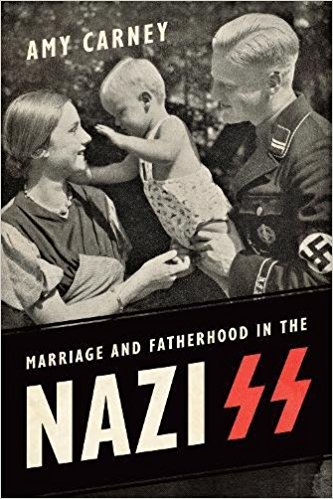
Academic Book Review: Marriage and Fatherhood in the Nazi SS, by Amy Carney

Based on unique documents from the archives of the SS, Amy Carney succeeded to create a comperehensive overview of the lineage families within the Nazi elites, mostly focused on controlled parenting and a complex genetical selection for professional assignments. After 1933, 'only a person who descended from a superior racial lineage would have the hereditary credentials to join the SS', part of the larger race-based policy developed at different levels of the German society.
It profiled not only the SS as a racial elite - with the genetic lineage the main element evaluating the worth of a person and his or her place within the hierarchy - but created the model for the entire German 'Volk' as well. 'Himmler tasked each SS man with the responsibility of fathering a racially healthy family; the duty was repeatedly emphasized in commands, rhetorics, and policy'. With a clear distinction of the roles within the family and the mission to provide to the society at least to two children per family, with the corresponding financial state-supported measures, those elites were already in place at the end of the war and the model survived at certain extent in the post-war Germany. 
Carney is mostly focused on the analytical overview of the policies during the Nazi times, with an explanatory approach which doesn't leave too much space for a critical and comparative approach on the sources. Given the novelty and extent of the information, which will extensively influence the content of similar approaches regarding the elites during that those times, the study is mostly self-contained and explores the material. There will be the duty of further academic studies to diversify the approach and create the theoretical models and support theories in this respect.

Rating: 4 stars
Disclaimer: Book offered by the publisher in exchange for an honest review