Showing posts with label history of germany. Show all posts

Sunday, March 7, 2021

Documenting ´A German Youth´


A German Youth, a French-Swiss documentary film co-production, that I watched yesterday on MUBI, diplomatically documents fragments from the rise of The Red Army Faction, a German organisation with terrorist minset created 20 years after the end of the Nazi rule. 

In the late 60s, the whole world was on fire: the Vietnam War was widely contested on the streets, the Cold War was close to his peak, the flower power movement anti-war and holistic in its world was preaching inner meditation and reaching peace - world and interior - including by using a complex drugs cocktail. Germany, too was affected, and offered its own version of coping with the new realities: The Red Army Faction (RAF).

20 years after the end of WWII, it was a new generation, born during after the terrible events, that was taking over. They were angry with their parents, they were angry with the establishment, they were angry with the world punishing them, the Germans. A German Youth, compared to artistic movies made on a similar topic, The Baader Meinhof Complex, documents those times, through archive films featuring the mentalities realm of the time. One can see the brave journalist Meinhof, smoking live while explaining to a row of old men about social justice, or the creative anti-establishment movies played, among others, by another founder of the movement, Gudrun Ensslin.

What the 1h30 documentary helps to understand is the intellectual background of the movement, with its philosophy of intellectual engagement - in the very military sense of the term. A fact that, didn´t occurred in the case of other similar movements in other countries. In France, the 1968 student protests did not lead to airplane hijacking or training by Palestinian military camps. Not too many made the lap to practice what they were writing. German youth did it again, and through the documented intervention one can easily see the roots, although there are a couple of missing chains.

For instance, there is not too much to be seen about the deep wounds of a generation trying to cope with the faults of the previous generation. The voices that Germans paid already too much for the Shoah were high and keep being loud since then. 

Another missing chain is the very complex Cold War background that cannot be ignored because it was very much part of the puzzle. At what extent was Soviet Union - through its usual Stasi-KGB strong chains (for instance, Axel Springer the verbal and physical target of RAF ideologues, the owner of Bild, on the forefront of the yellow press, was also very much involved against the Soviet Union and the division of Berlin, therefore an inconvenient ideological opponent - involved in maneuvring those ´german youth´? What about hijacking airplanes and killing people? Is it worth the cause? Obviously, RAF was by far more than an intellectual book club where people were fighting verbally, socratically, for their right to reach the truth. By not offering the entire contextual information, the risk is that again and again, the terrorism is glorified in the name of freedom and youth´s fight against the rigid academic bureaucracy. 

There is so much to be told about this ´german youth´ and any documentary testimony is important, with the condition of being critically weighted.

Monday, June 1, 2020

German Women on the Home Front

The title of this book is largely misleading as the women whose testimonies are featured are wives yet are part- or full-time employed. They are working in small shops, bakeries and employed in secretarial work that once the manpower is short, do adapt for working on production lines.
Besides the testimonies and some basic historic research the author is using no archives and other published works on the topic. Therefore, from an academic perspective, the testimonies do have a limited impact.
However, after a well-deserved filter of too much irrelevant information for the topic - including about the everyday marital interactions - the book can be used as part of a wider research about the role and social function of women during the 1939-1945 Nazi Germany. It starts from the membership into various girls´ organisations whose membership was based, among others, on the proof of ancestry, and the highly political/propaganda whose educational chore was to project an ideal of womanhood which was ´fit, healthy and beautiful´. The young women were supposed to help the ´survival of the nation´ through childbearing and intensive homecare activities. 
Interestingly, the testimonies are offering insights not only into the daily lives of women, but equally proves the rift between the generations and the slow wearing away of the social fabric during the last years of Nazi regime. 
It is an informative read but should be understood within the limits of the choice of testimonies themselves.

Rating: 3 stars
Disclaimer: Book offered by the publisher in exchange for an honest review

Wednesday, June 27, 2018

Movie Review: Luther

Financially supported by the Lutheran foundation based in the USA Thrivent Financial for Lutherans, this movie is both an official view on Luther as well as creates and enforces a founding German national myth.
It is directed by the Canadian film director Eric Till, which one year before this movie directed a production about the German resistance hero Bonhoeffer and admirably played by a selected list of actors, among which the impersonation of Luther, Joseph Fiennes, stands out as excellent. The movie was produced in 2003, more than 10 years before the 500 years of Reformation celebrated in Germany the last year. 
As a historical and religious character, Luther is both fascinating and controversial. He dared to fight against the powerful and deeply corrupt at the time Catholic Church, as well as created a German language-centered tradition and encouraged the spread of books and writings through the printing press. But he was as well highly controversial due to his strong anti-Semitism which was rarely brought into discussion during the 500 Years Reformation and it lacks as a critical approach of his life and works at his museum in Lutherstadt Wittenberg that I visited a couple of years ago. The movie do not tackle upon this issue at all, but at a certain moment it shows a Luther devastated that his writings created civil unrest leading to at least 100,000 deaths. However, the anti-Semitic tone of his writings is genuine and not the result of academic/theological interpretations. 
The Luther from the movie is going through pschotic episodes, of long solitude fights against the temptations of Evil, followed by serene moments of clarity. He looks like the tormented Romantic soul which cannot stand the corrupt system of the Catholic church and suffers deaply for the corruption of faith. Without the benefit of the strong support of a world institution, he dares to go on and defies the big power although at least at the beginning he was fighting mostly alone, if not the solidarity of the academic fellows from the theological university in Wittenberg.
The widespread use of the printing press and his courageous decision to translate the 'New Testament' in German, increased his credentials among the German nobles who will end up supporting him against the intrusions of Rome - particularly in the Catholic strongholds of Augsburg or Worms. 
Luther the movie has many strong images and a relatively simple, dichotomic structure - He versus Them. It is rich in symbols and meanings though that make it relevant for the student of the history of mentalities and with an interest in critical analysis of national and religious myths. 

Monday, June 25, 2018

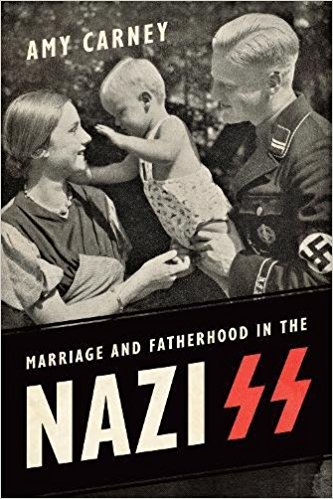
Academic Book Review: Marriage and Fatherhood in the Nazi SS, by Amy Carney

Based on unique documents from the archives of the SS, Amy Carney succeeded to create a comperehensive overview of the lineage families within the Nazi elites, mostly focused on controlled parenting and a complex genetical selection for professional assignments. After 1933, 'only a person who descended from a superior racial lineage would have the hereditary credentials to join the SS', part of the larger race-based policy developed at different levels of the German society.
It profiled not only the SS as a racial elite - with the genetic lineage the main element evaluating the worth of a person and his or her place within the hierarchy - but created the model for the entire German 'Volk' as well. 'Himmler tasked each SS man with the responsibility of fathering a racially healthy family; the duty was repeatedly emphasized in commands, rhetorics, and policy'. With a clear distinction of the roles within the family and the mission to provide to the society at least to two children per family, with the corresponding financial state-supported measures, those elites were already in place at the end of the war and the model survived at certain extent in the post-war Germany. 
Carney is mostly focused on the analytical overview of the policies during the Nazi times, with an explanatory approach which doesn't leave too much space for a critical and comparative approach on the sources. Given the novelty and extent of the information, which will extensively influence the content of similar approaches regarding the elites during that those times, the study is mostly self-contained and explores the material. There will be the duty of further academic studies to diversify the approach and create the theoretical models and support theories in this respect.

Rating: 4 stars
Disclaimer: Book offered by the publisher in exchange for an honest review